12/25/2016
By Carol Beuchat PhD
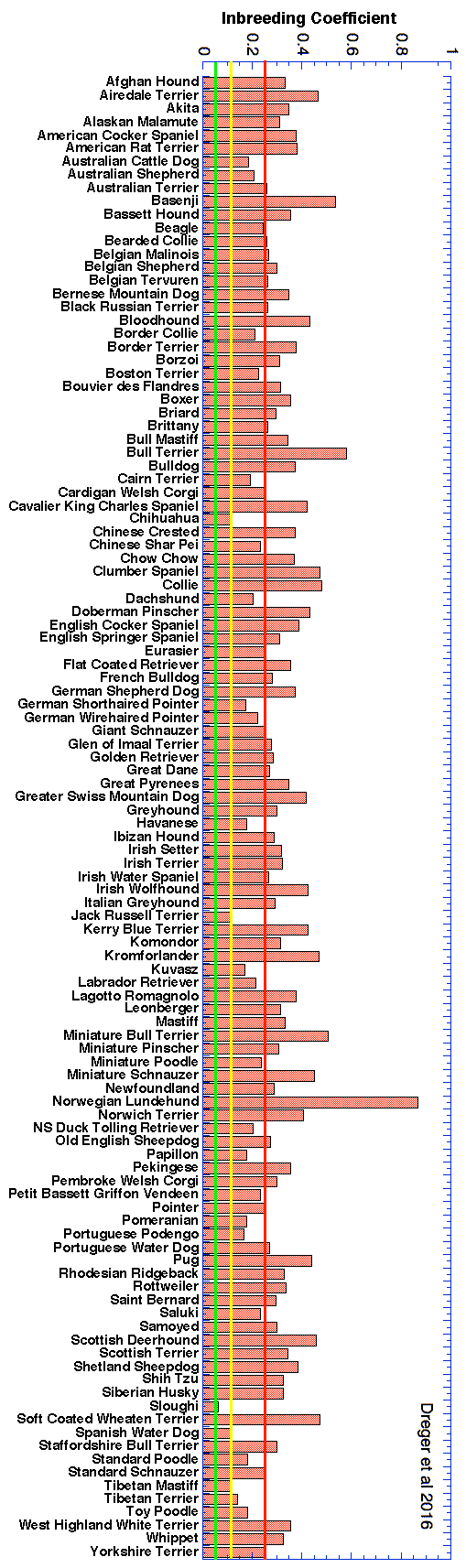
A new study in press (Dreger et al 2016) reports heterozygosity (inbreeding) for 112 dog breeds, determined several different ways. They computed inbreeding from pedigree data for 5, 10, and all generations in the database. They also determined genomic inbreeding using DNA analysis of SNPs (single nucleotide polymorphisms) as well as whole genome analysis.
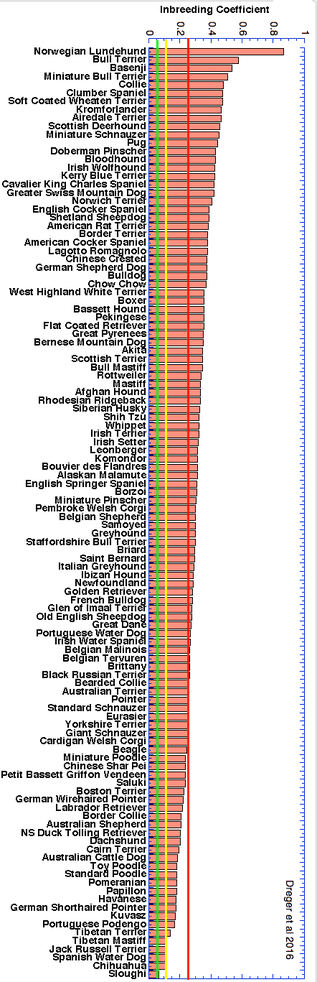
I have graphed the data for inbreeding (below) determined from DNA analysis (from their table S2). It is presented both alphabetically by breed (left) and by magnitude of the inbreeding coefficient (right). The lines indicate three levels of inbreeding: green is 6.25% (the result of mating first cousins), yellow is 12.5% (the result of mating half-sibs), and red is 25% (the result of a full-sib cross). For perspective, evidence of inbreeding depression in mammals (e.g., lower fertility, smaller litters, higher puppy mortality, shorter lifespan, etc) first appears at about 5% inbreeding, and the costs of inbreeding (including incresed expression of recessive mutations) usually outweigh the benefits above about 10%. (Read more about the costs and benefits of inbreeding.) Only the Sloughi is less than 6%, and the Chihuahua, Jack Russell Terrier, Tibetan Mastiff, and Spanish Water Dog are less than 12%. There are perhaps 20 breeds with inbreeding of less than 25%, and the rest are 25% or more.
The highest level of inbreeding by far (> 80%) is for the Norwegian Lundehund. This breed suffers from extremely low fertility and high puppy mortality as well as an often lethal gastrointestinal disorder. As a last effort to save it from extinction, it is now the focus of a cross-breeding program supported by the Norwegian Lundehund club and guided by an international group of scientists who are now reporting the successful production of F2 offspring.
Dit zijn de rashonden getest op alfabetische volgorde:
Dit zijn dezelfde rashonden maar dan gesorteerd op inteelt coefficient:
Het complete artikel staat hier: http://www.instituteofcaninebiology.org ... d-from-dna
En heeeeel in het kort komt het hier op neer: ze hebben DNA analyses gedaan bij rashonden, bij behoorlijk wat rassen. En de uitkomst is dat alleen het gemiddelde inteelt coefficient van de Sloughi lager is dan 6,25% (en je moet je daarbij voorstellen dat dit het resultaat is van een neef x nicht). Er zijn een paar rassen die onder de 12% zitten (de Chihuahua, Jack Russel, Tibetaanse Mastiff, Spaanse Waterhond) en bij 12% moet je denken aan een halfbroer x halfzus combinatie), dan zijn er ongeveer 20 rassen die tussen de 12% en 25% zitten (en dat is het resultaat van een broer x zus dekking) en de rest zit boven de 25%


 Want zolang er shows zijn blijft uiterlijk het belangrijkst (+de ego's)